Deep Value in Deep Water
Transocean’s balance sheet cleanup and premium fleet set the stage for outsized returns

Market Cap: $3,333,310,000
P/B: 0.30x
Net Debt: $6,174,000,000
EV: $9,508,310,000
Shares Outstanding: 1,072,242,035
Business Overview
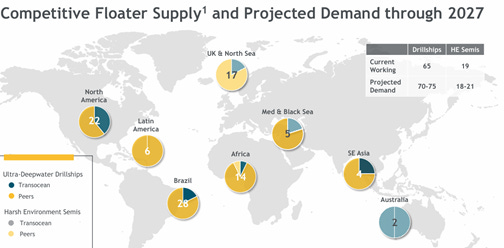
Transocean is the largest deep water contract driller in the world that controls the dominate market share of the world’s roughly 85 deep water drill ships that exist today. Transocean has 27 mobile units comprised of 20 UDW drill ships and 7 semisubmersible vessels.
Transocean owns the world’s only 8th Generation drill ships (8G), which provide for superior operating capabilities and economic advantages against the 7th and 6th generation models. Transocean’s fleet of drill ships, which is what we shall focus on in this piece, are a mix of mostly 7th generation vessels with 2 8Gs that are some of the youngest vessels on the market. While the service Transocean and its competitors offer is a largely commoditized offering, having a young fleet provides for improved economic profiles, better economics per well, and is a much more attractive product to an end customer who is increasingly concerned about operating safety post the 2010 Deepwater Horizon disaster that cost 11 people their lives, billions of dollars in clean up, and shut down an entire geography for oil development for 90 days.
Due to events like Deepwater Horizon, and other offshore oil development accidents, Blow Out Prevention (BOP) systems are a highly technical, important piece of equipment with younger 7G vessels having top-of-the-line safety features in the deepest, most high-pressure pockets of world hydrocarbon development. It is important that we use and pay a premium price to contract the best tonnage on the market given the world has largely found the easy to develop oil around the world and what we have left to develop offshore are deeper, higher-pressure basins that require best in class vessels and prudent fleet management skill.
The way the market stands today, supply and demand in the offshore drilling industry is increasingly favorable to vessel owners as it takes billions of dollars and 3-5 years to build a 7G or 8G vessel meanwhile, shipyards with the capability to build drill ship tonnage continue to consolidate by shutting down entirely or converting their yards to make alternative vessels that benefit the yard economics more so than building deep water drill ships.
While economics alone continue to discourage any additional capacity for offshore drilling, these are long cycles that take time to fully play out. Not only are you contracting a 7G or 8G vessel, but there is also the requirement of a Floating Production Storage and Offtake (FPSO) vessel that require billions to build, have similar shipyard dynamics and have a long lead time to build new supply. In addition to both a drill ship and an FPSO, these offshore fields are hundreds of miles offshore in difficult to navigate waters that further prove our point that great management teams and superior assets must be used to develop these critical offshore resources.
The current offshore cycle is further exacerbated by concerns over the worlds ever changing climate goals, that put into question the long term viability of a 7G or 8G vessel that have a 25-30 year useful life, meaning, a company investing in those assets today needs to be reasonably certain of an adequate economic return over a long period of time. While there is no threat of new building activity any time soon, lets assume offshore drilling activity inflects and rates 2-2.5x from their current levels, and lets say that takes place in 2027. A vessel ordered in 2027 would be delivered between 2030-2032, assuming a 25 year useful life that vessel’s life will extend through 2057 – are you, or anyone you know confident enough to make an investment of any kind over that long a period, never mind a cyclical industry like offshore drilling where hydrocarbon usage is being called into question with 2030 carbon reduction goals and carbon neutral goals by 2050?
It is our house view that we will be producing meaningfully more oil and natural gas by that period, however, we seem to be in the minority in holding that view and the market certainly disagrees with us as it is pricing all offshore services businesses as if they will have no terminal value after a mere 3-5 years based on the latent earnings power of these fleets – we do not think that is a reasonable view and therefore see a lot of opportunity in the UDW drilling stocks namely, Transocean.
As it pertains to Transocean, not only is the industry hated broadly and stocks are essentially left for dead, but while the rest of the industry ran for Chapter 11 protection in the last downturn of 2020-2021 and cleaned up their balance sheets, Transocean did not use the nuclear option and as a result is heavily leveraged and as of late raised a large amount of equity, diluting investors further which is way past “annoying” for legacy equity holders in this business. It is our belief that the latest equity raise, though brutal for all involved optically, is the last time the company will need to raise and, controversially, the raise was the exact right thing to do for a myriad of reasons that we will dive into in this piece.
Transocean stock has been brutalized for nearly a decade, and we are of the belief the market has overshot, pricing in poor earnings and subpar utilization rates into infinity which is not a thoughtful way to value any business – especially one that is in the process of a major inflection from rising demand from increasing offshore capex, as well as offshore economic advantages against onshore production, and a consolidation of the global fleet that will pressure vessel day rates to the upside for the next decade, we believe.
Thinking is always a critical element to any investment, but at inflection points it cannot be overstated how vital independent, variant perspective is as the next decade is set up to be radically different from the previous one. All the while passive capital, led by algorithmic trading based on a fact pattern of the last 20-30 years doesn’t lend itself to bottoms up company specific analysis on left for dead industries like offshore drilling – with that said, let us step away from the algo’s for a moment and lay out for you the company specific facts on the ground for Transocean that we believe will manifest the businesses earnings power over the next decade.
Historical Overview
Transocean dates back to the 1920’s with T.S Stoneman’s onshore drilling operations with Danciger Oil & Refining Company in Forth Worth Texas where he purchased the companies first oil rig and would later play a pivotal role in pioneering offshore drilling with “The Offshore Company” later in the decade. Fast forward to the 1950’s and efforts from Stoneman and his contemporaries leads to the first Jack Up (JU) rig as well as the first drill ship for deeper water exploration. The first JU in 1954 was known as Rig 51 and was followed by Sedco’s development of Rig 21, creating what would be a shallow water semisubmersible which is a part of the floater vessel family but operates in a few fundamentally different ways than a drill ship that has independent mobility.
The year that followed, 1956 saw Global Marine Drilling Company commission the CUSS I which would go down in history as the very first drill ship and operated in Trinidad before being contracted for its first multi well servicing in 1959 where subsea trees and flow lines or SURF technology was used to develop oil offshore Santa Barbra in roughly 300ft of water which is the depth of water we see JUs operate in today vs the 10K+ water depth Transocean’s modern drill ships can produce in.
Transocean’s legacy companies would continue to develop new technology and produce oil for roughly 40 years before the integrated entity Transocean that we know today was created. In 1993 Sonat Inc spun off its Sonat Offshore Drilling business that carried the ticker RIG on the New York Stock Exchange (NYSE) before acquiring Transocean ASA in September of 1996 and changing its name to Transocean Offshore Deepwater Drilling. From that point the amalgamation of the business we know today began on the back of an energy bull market and ever-increasing demand for hydrocarbons in all forms.
In 1999 Transocean merges with Sedco Forex which was Schlumberger’s offshore drilling arm and overnight became the world’s largest offshore drilling company before just three years later in 2001 completing yet another transformative acquisition of R&B Falcon’s 115 rigs, taking Transocean fleet at the time to over 200 vessels in total. Acquisitions continued through the early 2000s where in 2007 Transocean merges with Global Santa Fe (GSF) for a $53B deal that included payouts of $15B to GSF and a cash bonus to Transocean shareholders, reflecting the immense optimism in the oil industry broadly as prices per barrel were in excess of $130.
Post the deal with GSF, the entity that remained had $33B in contract backlog with over 20,000 employees. Net additions to the fleet did not end with GSF as the company continued to purchase competitors even as oil prices remained volatile through the Global Financial Crisis that occurred in 2008. In 2011 Transocean acquires Aker Drilling that added 4 HE rigs. Fast forward to 2018 and Transocean buys yet two more of its competitors in Songa Offshore and Ocean Rig UDW further expanding its UDW and HE fleets with the Songa deal alone adding seven floater class vessels and Ocean Rig UDW adding 11 floaters including a 7G drill ship with Songa being paid for with a mix of both debt and equity but required Transocean to assume $1.7B of debt from Songa.
Having built the world’s largest, highest spec deep water fleet Transocean used the 2010s to divest of its shallow water fleet selling its JU fleet to Shelf Drilling in 2012 with the rest sold to Borr Drilling for $1.35B in 2017. We think this move was a combination of a strategic focus on deep water fleet operations but is also, to a degree, a required move to avoid insolvency as oil prices remained increasingly weak from 2014 to the present and so to avoid a potential Chapter 11 proceeding the business figured it ought to raise some cash and focus its operations on one area of the offshore value chain – deep water drilling.
Transocean truly set the stage for the high spec drill ships we see today, incorporating Dynamic Positioning (DP) technologies first in the 1970s-80s to keep vessels in place without mooring and introduced the world’s first ever dual capability operations on its Discoverer Enterprise that allowed the vessel to perform two tasks at once which provided for a huge step forward in rig productivity, and by extension well completion times and economics. While innovation was Transocean’s edge at the outset of offshore oil production, this remains a core part of the businesses identity having contracted the world’s first ever 8G vessels that, along with upgraded mud systems, 20K PSI operating systems and increased hook load capacity decreased well completion time and costs by roughly 30%. In addition to the economics of the wells from new capabilities, the 8G vessels Titan and Atlas also operate on ultra efficient engines that reduce fuel consumption and emission on a per well basis which is an important step when thinking about energy return on investment or, energy needed to produce a unit of energy.
Asset Details & Locations
