The following is an excerpt from a client letter to our family office and high net worth clients. If you are interested in the full piece, and receiving market commentary & equity research in the future please reach out to us here or email at dw@sharmoscapitalpartners.com

“For at stake is more than the spread of free markets, more than the integration of the global economy. The forces behind the global economy are also those that deepen liberty, the free flow of ideas and information, open borders and easy travel, the rule of law, fair and even-handed enforcement, protection for consumers, a skilled and educated work force. Each of these things matters not only to the wealth of nations, but to the health of nations.
If citizens tire of waiting for democracy and free markets to deliver a better life for themselves and their children, there is a risk that democracy and free markets, instead of continuing to thrive together, will shrivel together.” President Bill Clinton, IMF Speech October 1998
“Mandating allocations of pension funds is a form of capital control…I have spent 10 years of my working life in China and many jurisdictions where there are capital controls. That is a different model and that is a difficult slope for an economy that believes it is an open economy” - CEO Lloyds Banking Group Charlie Nunn
Introduction
“If the abuses of treasures be dangerous, either by engaging the state in rash enterprizes, or making it neglect military discipline, in confidence of its riches; the abuses of mortgaging are more certain and inevitable; poverty, impotence, and subjection to foreign powers.” - David Hume Of Public Credit, 1752
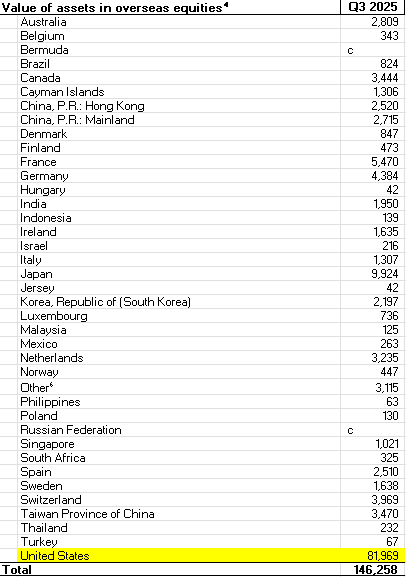
World War III has officially begun. We have experienced our modern-day version of Arch Duke Ferdinand assassination or the 1939 Invasion of Poland. While everyone understands physical violence, this is a war not of brass but of capital. This capital war was inevitable yet sat in the background for so many that is, until July 10th, 2026. Satsuki Katayama took the stage to call on the GPIF (a pension fund in Japan) to call home its capital from abroad. Japan is the 3rd largest holder of foreign assets behind only Germany and China. Japan holds $3.5T in foreign assets, $1.8T of which is held in the GPIF.
This action from the Japanese prompted Scott Bessent, the US Treasury Secretary to begin a direct capital war against Europe when it sold euro assets to buy the yen while opening FIMA lines to the Japanese. This implications for this capital war are massive and in the piece below we will discuss the importance of capital, where it is going, who is short capital, and the investment implications for a new financial regime.
Capital is a scarce resource that has been misallocated and abused for nearly two decades. When respect for capital goes away what transpires is periods wherein savings and revenue generated by private and public works flows to underproductive locations. When capital stops solving problems, capitalism stops working. Rest assured that developed world governments can only withstand this malinvestment for so long.
As time goes on and capital misallocation shows up in the daily lives of the constituent’s and politicians begin to take notice. Fringe characters like Mamdani or Trump get elected and government decides to step in and lend a hand in where savings ought to go. To round this point out capitalism and government overreach meet at the intersection of how a nation allocates savings.
There has been a myriad of monetary systems throughout the history of man but one thing that is certain is they all eventually cease working and collapse on themselves. This was true of the Gold Standard & Bretton Woods in the US while China had a Silver Standard, Britain a Sterling pegged exchange, among others.
Since 1994 however, a new system was born which is affectionately called The Non-System, a phrase coined by Paul Volcker to describe the world monetary order. Russell Napier argues the lack of a name or agreement to this system has distorted to worlds understanding of said system but, does not make the effects it has had on world markets any less dramatic.
We credit many of the current world distortions on the persistence of this current monetary system and think it is on its last legs. The system no longer works for the US or China and has not for China since 2014. When the world’s two largest economies are no longer benefiting from the system they are willingly participating in movement to something else will be done with haste and secondary or tertiary market calamity is just the cost of doing business.
As the worlds relationship with China evolves and nations are forced to face their ever-expanding debt burdens we think a scrambling for capital is inevitable. The US has been a massive beneficiary of home bias and capital has flown from Europe and Asia into US equities and government securities.
Importantly, not only has money flown to the US but Asia has dumped capital into European markets specifically French government debt. France finds itself in a particularly precarious position today with a deteriorating political system moving ever to the fringe actors. We think that the Eurozone system no longer works for France or Germany. The spread between their 10-year bonds has begun to widen as we saw in the 2011-2012 Eurozone crisis when French/German 10 year notes posted a 132bps spread.
A call for capital repatriation is not something that is coming, it is here already. Evidence of capital returning from whence it came abounds. It is not difficult to see capital is being called home but the effects that will have on developed nations with 250%+ debt/GDP’s while GDP itself continues to decline is disastrous.
The Non-System (1994-2026)
“Let me be more positive: if I had an agreement with my tailor that whatever money I pay him returns to me the very same day as a loan, I would have no objection at all to ordering more suits from him.” - Jacques Rueff (1965)
Monetary regimes are large, highly intricate systems that fluctuate throughout time. The typical monetary system lasts 20-30 years before it ceases to serve the originally intended purpose and dies out. While monetary regimes are quite complex there are some fundamental historical principles that can help rationalize how the world conducts trade.
In 1950’s during Bretton Woods the US stood in a league of its own with uncontrolled capital and strong market structure. Europe and Japan, having just been decimated by the World War II emerged as what I will refer to as the periphery. Periphery countries systemically control capital and weaken currencies while accumulating massive trade reserves. For the periphery to succeed it requires the center country (US) to lend long through foreign direct investment.
Eventually the periphery hits a point where the accumulated deficits and currency controls no longer benefit the nation and eventually, they graduate to the center and their currency floats. This is exactly what happened in the 1970’s when a floating rate regime was adopted but importantly, this was not because the way in which global trade had changed permanently, it was simply that another periphery nation or nations did not emerge to fill the role that Europe and Japan did.
Fast forward to 1980 and the failure in socialist systems and the failure of the communist experiment in 1989-1991 and developing nations came to the fore ready to fill a peripheral role. The role was filled by Asia and particularly China since 1994.
The system from 1994-2014 worked exceptionally well for China and saw the largest mobilization of agrarian labor in the history of mankind. The way the system worked broad strokes was starting in 1994 China made its currency cheap and held it there. This made Chinese goods exceptionally cheap with no risk to foreign buyers of prices moving against you. This led to a massive influx of orders for Chinese goods and the addition of China to the World Trade Organization (WTO) in 2001 was gasoline on the fire.
When a Chinese factory made and exported goods it was paid in USD. The factory then hands those dollars to the central bank in exchange for yuan. Importantly that yuan the central bank creates comes from nothing - financial alchemy in its most pure form.
Readers of our past letters will know that the creation of money in this way would usually be inflationary. This was not the case in China because the money being created into a rapidly growing economy. In other words, the supply of money was far outdone by the demand for Chinese goods.
Importantly China avoided a 1997-style crisis that engulfed Thailand because they did not accumulated dollars that they could not pay back, they were simply being paid in dollars. China then took those very dollars and indiscriminately bought US government bonds that pushed US interest rates down and allowed for US consumers to finance the purchase of more Chinese goods.
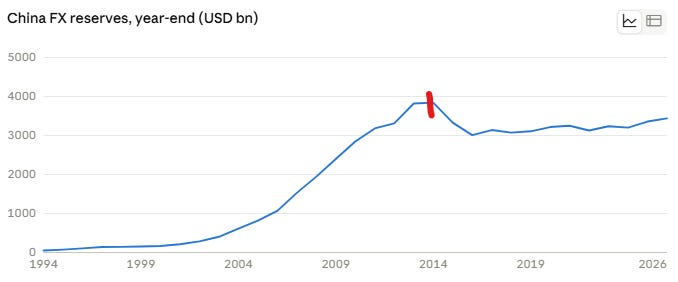
This system stopped working for China amid Bernanke’s December 2013 tapering with outright quantitative easing ending in October 2014. This was a problem for China because the dollar funding got scarcer and more expensive.
In 2014 China was nowhere near finished growing. The Chinese economy was still running at about 6% a year, and a country growing that fast needs its money supply to grow alongside it. The issue China faced was dollars dried up and Chinese exporters & borrowers were no longer bringing them to the central bank to be converted. The only path that remained to create them was for the banks to lend, and every loan comes with a debt attached.
This is evident when we look at Chinese foreign reserves, we see them peaking at $3.8T in 2014. A red line indicates in the charge below exactly where Chinese FX reserves peaked. Since 2014 new credit has become the only source of new money supply in China evidenced by the corresponding peak in FX in China coupled with PBoC balance sheet growth thereafter.
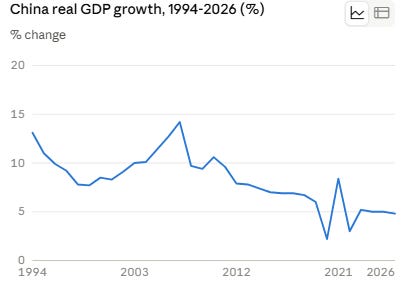
The problem that plagues China today is not just growth in credit, but the slow down in GDP growth. This slow down comes not only from the maturation of China but more specifically has to do with how much less efficient Chinese investment has become.
In 1990 China was investing in real infrastructure that added real economic value. A yuan created brought on ports, bridges, roads and added to the housing stock. It was widely estimate that yuan creation created a yuan of growth, a 1:1 ratio. By 2014-2015 the foundational things had been built and Chinese yuan creation decreased from a ratio of 1:1 to 1:4 or 1:5.
A perfect example of this is the city of Guizhou. Guizhou has 50 of the worlds 100 highest bridges in existence. The more shocking part of this story is that of the 31 provincial areas in mainland China Guizhou is 28th and has been the poorest province in recent history. This is alarming when you consider the country that has taken the lions share of the worlds tangible investment is doing a poor job of it. Not only is this a function of uneconomic industrial production and infrastructure projects but this is also how China keeps inflation out of its economy.
When money is created at such a grand scale one would imagine inflation was sure to follow. Knowing this, China restricted the flow of money to inefficient, government directed projects rather than going into the hands of the citizenry to consume.
China controlled capital by implementing more stringent reserving requirements for banks, capped deposits below inflation and kept its capital account closed. To give an idea of how strict China was, world average household consumption as a % of GDP worldwide is roughly 63% vs China’s at just 39% of GDP.
Less efficient spending pushing GDP lower coupled with the need to create more money via debt has caused Chinese Debt/GDP to skyrocket to what is clearly an unsustainable level. While the current non-system no longer works for China, the world is increasingly tiring of China’s antics.
No longer will the world sit idle while China guts their industrial capacity with the dumping of cheap, uneconomic goods. Not only is the US pushing back on this but India and Europe have grown tired of this as well. Countries around the world are putting up trade protections to block Chinese imports of raw materials.
Debt continues to accumulate in China, US/Chinese relations continue to deteriorate, and the world reaches a tipping point with industrial overbuilding from China, we think this system has failed and China will eventually float as all periphery nations eventually do. When that day comes it will be a massive shock to world markets and potentially geopolitical stability depending on what the system on the other side looks like. Large accumulations of physical gold from China and their clear interest in getting off the dollar point to a two currency system.
Cold War Turns Hot: US & European Capital Conflicts
Scott Bessent has been upfront about his policy stance as it relates to US government debt & and the relationship to the US/Yen valuation. Bessent & the US broadly have decided that volatility in rates and equity markets is an unacceptable outcome. Rather than allow calamity in US markets be it equity or debt, Bessent’s policy is to export it abroad. To do this, Bessent has decided to position the US as a white knight riding in to save our Japanese allies from an ever weakening Yen.
This was much more an attempt to save the US than it was to benefit the Japanese. The hot war in capital markets officially began when Bessent decided to purchase Yen by selling euros. The US only holds roughly $38B in FX $25B of which is euro denominated. The move to sell euros and buy yen while extending FIMA swaps to Japan was Bessent winking & nudging Japan to use its euro denominated assets to strengthen the yen.
While the US extends FIMA lines and offers support to the Japanese, France has no such ability. The problem with Bessent’s strategy is the sheer size of Japanese holdings of US assets. Japan holds $1.2T of US Treasury assets while holding just a few hundred billion of French assets.
Historically no matter when the US intervenes or for how long Japanese currency issues will not be resolved without policy change. That policy change needs to be higher rates which is a tough task given Japanese 300%+ levels of debt/GDP and benign GDP growth. Turns out deficits do matter.
Looking around we see two common themes. The first is developed nations with massive amounts of debt. The second is a clear interest in bringing capital back home first with incentives but as conditions deteriorate further governments will compel capital. For our purposes we will discuss examples in the US, Japan, France, South Korea, Canada, Norway & Britain.
First, lets address the constraints all these countries share - high levels of government, household, and non-financial corporate debt relative to the growth in their gross domestic product.

For Japan an inflection is upon us which threatens to unwind the carry trade and rapidly increase debt payments. Japan has a tight rope to walk where they need higher rates to strengthen their currency but simply cant do it without creating a credit crunch. As a response to Japanese growing demand for capital it has called on its pension funds to boost domestic investment. Another way we see this need for capital manifest is the 2027 tax reform in Japan aimed at household ownership of JGBs. Roughly 2% of households in Japan actually own domestic government debt - this is unacceptable for Japanese policy makers.
France, despite having lower overall debt/gdp than Japan is arguably in a worse position. Tied into the eurozone and handicapped by a single euro system does not allow for much flexibility. France also has over 100% of its GDP in debt securities held by foreign nations - the same foreign nations that are now capital starved themselves. French policy makers have responded by trying to coerce capital from the citizenry into tax advantaged vehicles aimed at defense spending.
Canada finds itself in a precarious position with all three levels of debt ownership, household, government and non-financial corporate at 100%+. Canada, like France and other debt strapped countries in need of capital are using defense as the mode for which capital shall be compelled. Canada Strong directly positions the country in opposition to the US and claims the countries very sovereignty is under attack. The Canada Strong plan lays out a framework for the rebuild effort with headlines like Secure, Protect, & Build.
Clearly Canada is interested in bringing capital home to attempt to insulate itself from the weight of its debts. Canadian pension funds are all invested heavily in foreign markets and the compulsion and incentives for those funds to come back home is developing as we speak. In a paid advertisement in Canadian newspapers 90 domestic company CEOs called on Canadian government to incentive/persuade Candadan pension schemes to bring funds back to Canada.
Canadian pensions hold 37% of all Canadian institutional savings and have cut their Canadian public equity weightings from 28% in 2000 to just 4% at the end of 2023. The letter goes on to say they are not interested in government telling pension funds where or how to invest while in the same breath says governments possess the right, responsibility and obligation to regulate how this savings regime operates. If Canadian governments are short capital they will make sure they are funded and it is Canadian savings that will be the medium.
The final part I have to mention on Canada that goes along with our earlier discussion on China is the third piece of Canada Strong - Build. This section begins with “We used to build things in this country”. How funny it is that western countries are seemingly just waking up to the fact that we have under invested in and cut industrial capacity. This also helps make our point that governments will use all sorts of moral suasion to bring capital back and including patriotic means like rebuilding infrastructure domestically and will resort to fear based tactics like looming threats to sovereignty such as Russian or Chinese invasion. If that proves not to work, which economics will ensure, the government will become more directly involved.
China is in a unique situation where it has capital at home but lacks the necessary inflation required to erode its debts. China’s main mechanism is to get dollar holders to convert to local currency. China has done things at the margin like cap US dollar deposit rates but the problem China actually has today is capital conversions at too high a pace. If too much capital is converted from USD to local currency it makes said local currency stronger, which then makes Chinese goods more expensive abroad. This comes at a time where Chinese domestic consumption of is weak and exports are more important than they have been in a long, long time.
This would also compound Chinese debt/gdp which is already at unsustainable levels. 32% of Chinese GDP growth in 2025 came from exportation - if that begins to reverse on what is already an overall decline in GDP growth in recent years Chinas problems only worsen.
Norway is heavily indebted as well and not only is looking to call capital back home but is directing its efforts at the United States. Norges Bank Investment Management wants to cut the government bond portion of its $2.3T sovereign wealth fund which would decrease its holdings of US Treasuries by $80B which would be roughly 40% of its total $215B position in US government debt.
Norway is also in a position where 22% of GDP is oil related, 32% of government revenue is comprised of oil sales and 48% of the country's exports are oil. Uniquely, Norway pension assets are mandated to invest overseas with roughly 98% of pension assets in foreign holdings. Roughly $1.65T of assets sit in equities with the majority of that allocation in the US. The problem with Norway, as is the case with many countries looking to benchmark is a 72% of the MSCI world index is US equity related therefore, that is what they must own.
The US finds itself heavily indebted as well and the prevailing view is we can simply print our way out of problems. This has caught up with the global hegemon and we find ourselves in the awkward position of inflationary pressures that need controlled while being unable to have a policy rate that truly matches credit risk because debt levels are simply too high. The constraint around the world is debt - full stop. I think the US is likely in a less dire position than Japan, Europe or China and will not see massive capital repatriation until later on this decade. The US will for certain need to inflate away its debts and will likely take the same route as other countries have. Defense spending, AI infrastructure spending, friend-shoring and similar buzz words will likely lead the conversation around capital funding requirements.
The US today runs a pension book that is roughly 2/3rds domestically invested. I would also argue the Inflation Reduction Act (IRA) was a form of US capital control lite. The activities proposed by the Biden Administration would have accelerated the rate of inflation, but that was never the goal of the plan anyhow. The IRA was a holistic investment plan aimed at friend shoring and domestic infrastructure broadly. What the Biden and Trump administration fail to realize is that if they would simply allow economics and free markets to do their magic capital will come to the US anyhow. The industrial advantage the US possesses ensures this trend however, we continue to bat it away and delay what would otherwise be a positive for the US broadly.
For South Korea’s part there are a myriad of examples where capital controls are actively being implemented. As an example the BOK caps annual outflows to the US and has announced a tax incentive in December of 2025 that would exempt capital gains on the sale of foreign assets if that capital was then reinvested in Korean domestic assets. The Korean National Pension Service (NPS) holds 35% of its assets overseas vs 14.9% in domestic Korean equity. If we assume benchmarking is held up then roughly 60-70% of those foreign funds would be in US specific equities.
Importantly this is equity that has done quite well and it seems the avoidance taxes on what are likely large capital gains would be financially attractive. South Korea has caught backlash for its effort to secure capital. Washington decided to pull from joint military exercises in the region for what seems to be South Korea’s unwillingness to comply with US stated monetary goals. The threat to Asian nations ex-China seems to be, do what the US wants or we will stop supporting you against Chinese aggression.
Finally for the UK they find themselves indebted yet, not as badly positioned as some of the other countries on our list. Despite being less indebted than some other developed nations the UK offers some of the stricter capital controls and regulatory intervention in reinvigorating home bias as any country. The Mansion House Accords is a direct allocation of UK pension assets into domestic assets. Seventeen pension companies managing 90% of active savers in the UK agree to the Mansion Accords, an accord that the Russell Napier points out was called a capital control by the CEO of Lloyds Bank.
The Accord pledges 10% of workplace portfolios with half of it to be invested in domestic infrastructure and private equity by 2030. This new source of funds is expected to be sat aside for clean energy, and public works. The other notable point is the legislation points to Australian pension schemes being more invested in private markets than the UK - it seems to us private capital would be easier to compel for both governments and the owners of said funds, no? An opaque asset class that marks to a model could hide losses in a way publicly quoted bond or stock prices simply don’t allow.
A Note on National Savings
Personal savings rates around the world vary by country while in the US we are near the bottom of OECD savings rates, Japan and France have domestic savings they can use to pool funds where the government deems necessary. The word that best describes how governments will come for your savings is prudential regulation - in other words, the road to hell is paved with good intention. The government is not going to directly come out and tell you they are taking your savings, instead it will come slowly with incentives and carrots. They will implement such a strategy until a point comes where crisis requires more punitive action. Capital controls that restrict the free flow of funds, anti-free market taxes on transactions of capital flows that don’t meet the government objectives, etc.
I agree with Napier’s conclusion that French or Japanese savers will be the first victims of this repressionary regime and the need to inflate away debts. The form in which it takes will be interesting to see unfold. It appears Japan will be the first to move as it has an immediate currency problem that makes its imports more expensive which, doesn’t lead to the kind of inflation required to inflate away debts and doesnt sit well for a population that imports 60% of its caloric intake. The reason is that inflating away debt requires nominal GDP growth, meaning domestic wages and prices. As such, we think given Japan’s immediate currency crisis it is likely they need to bring more capital home fast as well as raise rates and strengthen the yen.
The other end of this trade is going to come from the US or France which are the two largest pools of capital Japan can pull from. The US has done what it can to redirect those asset sales to Europe with particular emphasis on France. While Bessent makes silly comments about exporting volatility elsewhere make no mistake there is contagion risk. France is tied into the world banking system in a major way and dwarfs the rest of the eurozones weighting in global markets. France is also a lender of liquidity to US markets and should they struggle US markets and corporations will feel the pinch.
Concluding Thoughts
Across the world debt relative to GDP has compounded at an alarming rate. Similar to each bull or bear market turn, there is always a headline to solidify how far the pendulum truly has swung. Some examples of the US position toward debt is summarized by Alan Greenspan and Dick Cheney. Greenspan in 2011 famously said "The United States can pay any debt it has because we can always print money to do that. So there is zero probability of default". Nine years earlier in 2002 Dick Cheney was on record saying "You know, Paul, Reagan proved that deficits don't matter".
It is this exact attitude that allows something like debt accumulation to compound for so long without worry. What Cheney or Greenspan failed to realize is that the only bad outcome for debt is not default. Simply because the US can print its currency and therefore default is unlikely, does that mean we can or should accumulate such massive fiscal burdens? While default is not a situation we underwrite for any of the countries above, of all the options nations have to deal with debt Financial Repression is the only way we see our debts being dealt with. The idea that we can grow at 3-4% real for the foreseeable future is possible but not probable.
For reference, the US has grown at 3-4% real on a handful of occasions. The first was 1947-1973 in the post war boom where productivity gains were real and growing rapidly and our labor force was nascent and growing quickly. We also saw this level of growth in the 1983-1989 rebound in the Reagan Era. In this period inflation came down radically and we had just come out of a massive recession that saw the stock market move sideways since the 73’-74’ crash of the Nifty Fifty. The final period of record is the 1996-2000 Tech boom which also saw physical growth to feed the growing appetite of China for tangible goods.
During all these periods productivity gains were 2.5% - 3% per annum vs the just 1.5-2% we have seen in recent years despite the massive tech run we have been on since the GFC. Real GDP growth in the post GFC era has averaged 2%, an amount sufficiently under that required to grow out of our debt burdens. In the same breath, Chinese GDP growth has been 6.9% per annum since 2008, 1.0% for France, 0.4% for Japan, 0.8% for Germany and 1.8% for Canada.
If it is unlikely we grow our way out the worlds debt burdens and assuming no one wants default or hyperinflation it appears financial repression is the only politically tolerable path that we have utilized before.
The investment implications for a changing monetary system around controlled flows and a floating rate China are enormous. The first thing that comes from this is the physical world benefits greatly. That capital flows to domestic sources used for building things that actually grow GDP and benefit the domestic market. We also think in a period like this that asset selection and active management becomes increasingly important.
As a brief example, rather than buying a European basket of equities, looking at a country like Germany vs France where Germany is only 180% debt/gdp vs French 300%+ may be a more interesting place to hunt. We also think the UK is incredibly well positioned and investible in the next decade as you are getting a combination of low valuations and a market that has performed poorly because it has spent a long time post the GFC unencumbering its households and industry. Corporate debt for the UK for example is lower than any other country we discussed at just 59% vs 90% in Q4 2008.
2027 is likely to worsen risk around the world particularly in Europe where fringe characters in Germany and France seem to have stolen the show. Should France
We end this piece with a quote from David Hume who in 1752 said “either the nation destroys public credit, or public credit destroys the nation.” Indeed.